

How Learning Contexts Drive Evaluation Choices
Welcome to Insights & Opportunities: A Hub for Informal STEM Education! Insights & Opportunities is a twice-monthly newsletter for educators, administrators, legislators, and advocates who recognize the importance of informal STEM learning.
This newsletter is brought to you by me, Sarah Dunifon, and my team at Improved Insights. I’m a long-time STEM educator, researcher, and equity advocate. Along with my team, I now work on cutting-edge informal STEM learning research and evaluation.
Each edition of this newsletter offers exciting insights, resources, and opportunities for informal STEM learning professionals, including funding, jobs, professional development, informal STEM learning research, evaluation tips and resources, and so much more! We hope you find it valuable. Now, let’s get started.
How Learning Contexts Drive Evaluation Choices
Folks looking to increase their knowledge and use of evaluation often jump straight to the evaluation tools they hope to use. A better first step is to clearly understand your context, audience, and needs, then develop your methodology around those pieces. As summer programming approaches, let’s revisit the differences in learning contexts that may drive evaluation choices. In this feature, Dr. Sarah Dunifon explores formal and informal evaluative work, their differing purposes, and evaluation priorities. To read the full article, check it out in our Insights. In the meantime, here’s a taste:
–
When I describe my work to folks in the formal education world, I often find that they are surprised by the significant differences in formal and informal evaluative work. “Evaluation” can mean drastically different things in formal and informal education.
[...]
This month, I’d like to shed some light on the differing purposes of evaluation within formal and informal evaluative work. First, I’ll briefly explore evaluation through a formal education lens. I’ll then provide a more thorough review of informal education and the evaluation priorities within the informal education world.
Formal Education
First, let’s define what we mean by “formal education.” When I reference formal education, I am talking about learning that takes place specifically in a classroom setting (K-12, higher education, etc.). Of course, the pandemic has shifted the definition of what a classroom constitutes, so a classroom setting would also include virtual schools and online learning within a formalized school context (e.g., online colleges, K-12 virtual academies, etc.).
Traditionally, formal education assessment focuses on learning gains within a learner or group of learners, primarily in the areas of content knowledge and skill development. Skill development can be in specific subject areas (like STEM skills), cross-curricular skills (like conducting research or evaluating sources), or in other areas like social-emotional learning (SEL) and 21st-century skills. Formal educators are interested in answering questions like: “Are students learning what they need to be learning?” and “Are students where they should be at this point in their education?” Another priority is verifying that the skills students are developing as a result of their classes align with the scope and sequence, and curriculum.
To read the full article, check it out in our Insights.
60-Second Suggestions
Here are a few of our favorite things this month, usually pertaining to informal STEM education and evaluation, but occasionally some fun personal stuff, too.
This panel session, which took place during the 2026 NSF Advancing Informal STEM Learning Awardee Meeting in February, provides an overview of informal science education networks, associations, and repositories that are essential to the broader informal science education field and to improving the quality of informal STEM learning.
This article from Afterschool Alliance reviews the initial analysis of their nationwide survey of out-of-school time STEM programs’ community impact. Over 250 programs engaged with the survey, and results revealed insights about the geographic distribution of programs, how STEM can act as a vehicle for addressing community issues, and what youth leadership looks like in STEM initiatives.
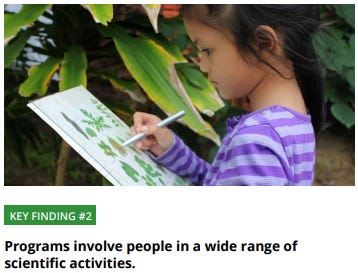
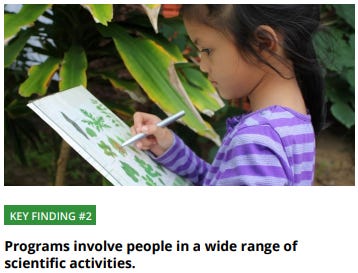
This executive summary from eeWorks examines research conducted by UC Davis on how citizen science initiatives support environmental education objectives. The research concluded that community and citizen science programs can achieve science education goals, and researchers identified seven key findings about these programs and their contributions to environmental education.
Opportunities
Check out these new opportunities for the informal STEM learning community.

Funding:
2026 HHF Program Grant, Hulsebosch Hope Foundation (HHF), variable. Mid-sized, growth-oriented public charities in the city of Chicago are invited to apply for program funding that supports quality education, among other core areas. Programs should serve under-resourced communities, particularly in the south and west sides of the city, and align with focus areas including afterschool programs, enhancing early childhood education (ages 0-3), and workforce training, among others. Prospective grantee surveys are due April 30, 2026.
2026 Request for Applications, Native American Agricultural Fund (NAAF), variable. Nonprofits, educational, and other community-minded organizations serving Native farmers and ranchers are invited to apply for funding to support agricultural education, business assistance, technical support, and advocacy services, among others. Applications are due May 1, 2026.
Kubota Hometown Proud 2026, Kubota, $50,000. Nonprofits are invited to submit applications for community-led project funding. Previously funded projects include agriculture education centers, all-access parks, and open space preservation projects, among others. Applications are open April 1-May 7, 2026.
Resilience Education, National Academies of Sciences, Engineering, and Medicine, $100,000-$750,000. Nonprofits, K-12 schools, institutions of higher education, state, and local entities (excluding federal agencies) are invited to apply for grants for programs that increase the environmental literacy of community members across the U.S. Gulf Coast states (Texas, Louisiana, Mississippi, Alabama, and Florida). Programs should engage learners in place-based, solutions-oriented activities tailored to community needs and contexts. Applications are due June 10, 2026.
Student STEM Enrichment Program (SSEP), Burroughs Wellcome Fund, up to $60,000. Nonprofit organizations, community groups, museums, zoos, and public and private schools in North Carolina are invited to apply for grants in support of diverse programs that enable K-12 students to participate in creative, hands-on STEM activities. Programs must employ inquiry-based avenues of exploration. Applications are due June 10, 2026.

Jobs and Fellowships:
Interpretation Program Assistant & Youth Education Programs Assistant, Coastal Maine Botanical Gardens (Boothbay, ME), $18.75/hour (Seasonal). The Interpretation Program Assistant will support the Interpretation & Exhibits program with administrative and programmatic responsibilities, including guiding tours, interacting with visitors, assisting with event set-up, evaluating programming, and maintaining exhibits. This position is active late April through mid-October, 2026.
&
The Youth Education Programs Assistant will support youth educational programming with administrative and programmatic responsibilities, including welcoming school/youth groups, assisting with classroom lessons and field studies, assisting with the implementation of summer camps, guiding garden walks for families, and other education programming activities. This position is active late April through mid-September, 2026.
K-12 Education Specialist, McDonald Observatory Visitors Center (Austin, TX), $42,000. The K-12 Education Specialist will develop and deliver K-12 educational programs, conduct evening and daytime programming for visitors, and assist with community activities, special projects, events, and programs on and off-site.
Learning Engagement Specialist, Alaska SeaLife Center (Seward, AK), $20.35/hour+. Education Specialists will be responsible for developing and delivering engaging interpretive learning experiences emphasizing conservation, empathy, scientific inquiry, and inclusivity, highlighting Alaska’s unique ecosystems, wildlife, and cultural heritage. They will engage diverse audiences through onsite programs, virtual learning, and community outreach. Salary enhancements are available for Education Specialists with previous experience in educational roles, with coordinating and planning learning programs, curriculum development and instructional design, and familiarity with state and national K-12 education standards.
Program Leader, LIGO Science Education Center (Livingston, LA), $89,000. The Program Leader will actively lead LIGO Livingston’s education and public outreach team to develop and execute education programs, including K-12 field trips, teacher professional development, and public events. They will also manage exhibits and other educational offerings, and develop and maintain education partnerships.
School Programs Coordinator, Wave Hill (Bronx, NY), $50,000. The School Programs Coordinator will facilitate and oversee all learning experiences for students in pre-K to 12th grade students including in-person and virtual academic year field trips, and summer camps. They will collaborate with educators to research and develop lesson plans and ensure efficient administration of all school programming.

Professional Development:
2026 AERA Annual Meeting, American Educational Research Association (AERA), April 8-12, 2026 (Los Angeles, CA). The American Educational Research Association will host its 2026 AERA Annual Meeting, Unforgetting Histories and Imagining Futures, in Los Angeles, CA. Over 2,500 sessions will explore the conference theme, providing dynamic experiences to learn from prominent scholars, discover the latest research, engage in stimulating conversations, and foster professional relationships. The conference will take place April 8-12, 2026.
2026 Conference for Advancing Participatory Sciences, Association for Advancing Participatory Sciences, May 26-29, 2026 (virtual). The 2026 Conference for Advancing Participatory Sciences will feature symposia, topical sessions, and collaborative discussions that will highlight research, sustainable funding, global challenges, and other relevant topics within the field. The online conference will take place May 26-29, 2026.
Course: Biodiversity Education, Cornell University Civic Ecology Lab, April 20-May 17, 2026 (virtual). Join Cornell University’s Civic Ecology Lab for their 4-week global online course, Biodiversity Education. The course will run from April 20 to May 17, 2026, and will explore the connection of biodiversity concepts to teaching and help educators teach biodiversity in ways that are engaging, locally relevant, and connected to real-world efforts. Participants will develop a plan for biodiversity education/stewardship action, and those who complete the course will receive certification documenting 25 professional development hours.
NAAEE 2026: Imagine If…, North American Association for Environmental Education (NAAEE), October 6-9, 2026 (Portland, OR). NAAEE is seeking proposals for presentations for its 55th annual conference. The conference will be held in Portland, OR, October 6-9,2026. NAAEE is inviting proposals that speak to the overall theme, “Imagine If...” and that spark imagination and action, broaden participation and belonging, elevate promising and proven practices, and inspire creativity and leadership. Proposal submissions are due April 10, 2026.
Nature-Based Early Learning Conference, Natural Start Alliance, June 24-27, 2026 (San Antonio, TX). Join the Natural Start Alliance for its annual Nature-Based Early Learning Conference. Nature-based early childhood education professionals will gather in San Antonio, TX, June 24-27, 2026, to explore strategies, report on new and relevant research, share best practices, and examine other topics related to the field.
Thanks for tuning in to this edition of Insights and Opportunities. While you’re waiting for the next edition, tell your friends! We appreciate you sending along a blog post you enjoyed, a job opportunity you think a friend should apply for, and resources you found valuable. Sharing this newsletter is the best way to support this work. Until next time - thanks!
